Tag Archives: raising boys

Ode to my mother

Lessons learned from a lifetime of adoration

A few years ago, I sought the counsel of a therapist. I didn’t really know why at the time but it was most probably prompted by the complex relationship I shared with my mother—a journey that you may have ventured on or will someday. Such is the power of mothers, an influence that often lingers even when we seek to break free from it. We mothers, unwittingly or not, inherit this remarkable ability to shape the lives of our children, occasionally repeating the very patterns we vowed to avoid.

As a child, I adored my mother. As an adult, I still do. I adored her so much that I could not fathom why she wasn’t reciprocating and chose also to love others (I have four older siblings). I yearned for her attention, puzzled by her choice to spend time with friends rather than shower me with her undivided focus. I craved her presence, wishing she would cater to my every need, whim, and desire. I couldn’t understand why she wasn’t my devoted servant. After all, so many of my friends seemed to have their mothers doting on them incessantly.

Little did I realize that beneath this perceived neglect lay a treasure trove of life lessons, perhaps the most crucial being the one I treasure most. Here’s what I’ve learned from a lifetime of adoring my mother:

  • The value of timeless elegance and ageless glamour. You are never too old to be glamorous. Keep on updating your wardrobe, buy new shoes and bags. And always accessorize, even when alone at home.
  • The significance of self-care. Self-care is a necessity, a testament to self-worth, not merely a privilege. Regularly pamper yourself with blow-dried hair, vibrant nail polish, and the allure of new makeup.
  • The art of generosity. Keep your fridge well-stocked and your front door open. You will never be lonely if you offer to feed people.
  • The appreciation of beauty. Infuse your living space with the charm of flowers, even if it means plucking them from a nearby bush or a forgotten garden.
  • The power of a smile. Even when delivering candid feedback or a pointed remark, do so with kindness and a warm smile. It’s amazing how gracious words wrapped in a smile are more readily accepted.
  • The value of friendships. Keep your children close and your friends closer. Your children are precious but you’ll probably have more fun with your friends. Prioritize time for them. They’ll be there when you need them.
  • The essence of curiosity. Nothing will keep you younger than the continuous hunger to know new things. Stay interested to stay interesting.

But if I had to pick the one lesson I have learned from my mother, it is this:

My time has value. I have value.

People often commend me on raising my three children, of whom I am immensely proud. They express surprise at our continued closeness as a family, even now that they’ve grown up. I credit this to this secret formula from my mother’s lab: when you appreciate your own time and worth, others will do the same.

In retrospect, I recognize that my mother’s approach of not fawning over me (and hence me not fawning over my own children)—stepping away from my demands, seeking her own sanctuary (been there, done that), gently silencing me during her conversations with friends (guilty), and prioritizing her own activities over chauffeuring me (ahem)—wasn’t an absence of love. Instead, it was a gift of space, a lesson in self-sufficiency, and the most valuable lesson of all: Even as a mother, I am first and foremost me. My time holds significance, and I need not wait for others to acknowledge it. I entertain myself, for my time has value. I care for myself, for I have value. And for that, I am, and will be eternally grateful.

On parent-counselling through the university application process

This article also appears at www.uni-versed.com

Yesterday my son fired me. As his admissions counsellor, I am devastated—no one likes to lose a client. As his mother, I think he did the right thing. I had pushed too hard, tightened the grip a little too much. I think I may even have been rude.

Now, I can finally stop hounding him about how he is not doing enough to prepare for his application to the highly selective (or rejective) university of his choice and start being more of an emotional support in this very stressful phase of his life.

As his counsellor, I know he needn’t be stressed if he is putting in the work necessary to become the highly academic student his chosen university is looking for. I even told him exactly what he needs to be doing. As his mother, I know he will eventually find his path, regardless of his choices and his options. I know him like that. As his counsellor-mother, however, things got a little confusing. I made it a point to remind him daily that what he was doing was not enough, yet.

A few weeks ago I published an article about how to parent during this stressful application period. Over the years, and with two children already tucked at university, I had figured out how to parent through the process. What I hadn’t learnt was how to be mother-counsellor. It was my first time.

The role of a mother during the application process is to lend a non-judgmental ear, offer emotional support and make sure her child has their minimum food and security needs fulfilled in order to thrive. It is a role that is highly subjective and fraught with emotion. The role of a counsellor, on the other hand, is to be objective, offer the best of their knowledge and advice and guide the student and their parent through the process. You can see where the problem lies: I was emotionally invested in a process I am meant to be scientific about.

My experience had taught me to recognize when a student is not yet ready to apply to a high-achievement/high-expectations university such as that chosen by my son. As a mother, I never allowed myself to say it—I did not want to deflate my child’s confidence and kill his drive. As a counsellor, I would also never allow myself to tell a student they have no chance of making it. Firstly because I don’t know that for a fact, I am only intuiting, and secondly, I actually believe in aiming high—if you can handle the potential rejection—because aiming high allows you to put your best foot forward and give your application your best shot. I am a great believer in the shoot for the moon, land on the stars plan.

What I never ever did, until just before I got fired, was to blurt out: “You are never going to make it if you continue like this.” As I said, as mother-counsellor, things got a bit confusing. I like to believe that I am a good mother and my testimonials tell me that I am a good counsellor. But a mother-counsellor combination takes on a life of its own, a hybrid model bringing out the worst in both. So while I am devastated to have lost a client, I am delighted to regain my son. I wish him the best of luck, I believe in him and I know that he can do it, and I am by his side for whatever emotional and logistical support he needs. As for him, I think he’s just happy to have his mother back.

Run now.

Here is a sentence a 16-year-old will never believe: “we slow down as we age.” I know that because I have one. The disbelief probably stems from a teenager’s simple inability to even conceive of a future so far ahead. They live in the present, as they probably should.

Yet, precisely because teenagers cannot, and do not, particularly focus on a too-distant future, I hope to share with them a piece of advice I wish I had been given myself when I was a young girl growing up:

Run now. So that when you’re older, you can slow down to a brisk walk. 

I am not old. Yet. But what is for sure is that I am not young either. Let’s just say that I probably have less to go with the same health benefits I have been the grateful recipient of so far.

When I was young, I hated running. I was the slowest, the most breathless, and the least graceful. I used to hate getting sweaty, dirty and I certainly hated pushing beyond what was absolutely necessary to achieve the minimum required results. I had other talents and aptitudes but neither I, nor my parents, saw the need to develop them any further. VCRs and game consoles were a new thing then and there were plenty of movies to watch and games to be played.

Also, I couldn’t see the point of running or exercise in general. I was brought up believing that exercise was for the sole purpose of losing weight a.k.a. suffering. Why suffer? There was a good movie on the new VCR and a bag of chips to be enjoyed. Where was I going to get to by running anyway? 

Here is the question I didn’t, and should’ve asked: where was I getting to sitting on the couch? 

Now I know.

In my 20s I really wanted to be a runner (I still do). I loved the idea of it, the rosy cheeks, the runner’s high, and of course, eating what I wanted. I dabbled with running. I was slow, I was breathless and as soon as I reached the goal of running for 30 straight minutes I would stop. Going further was absolutely out of the question. Too much hard work. There were drinks to be enjoyed and TV series to watch.

Idem in my 30s—except that now I had the perfect excuse(s). I could go out for a run but the children might go hungry. (They didn’t.) Also, I needed my daily glass of wine to get me through the boredom of young motherhood. 

When I was 40 I decided I to run a marathon. All the running manuals said to get mileage under my feet first, to stop the alcohol and to watch what I ate. But I had no time and energy for all that. I had three kids at home, I was trying to get a writing career off the ground and I had something to prove: that I was, and will be a runner. During the race, I pushed really hard. I pushed so hard for over 5 hours that I decided this was way beyond how long anyone should push for. The marathon was my one and only. I stopped running for years after that.

Today I want to run but the most I seem to manage in my Zone 2 training is a brisk walk. But if I am at a brisk walk now, what of the future? How slow will I get?

Now I wonder what would have been had I pushed through my slog when I was a little girl. If I just had it in me to run through the shame of being the slowest, the least graceful. I wonder where I would have been if I had the tenacity to push beyond the 30 minutes of sweat, if I could only stick with the tiredness, embrace the suffering for just a little longer. Just one more day. Just a minute more every day. 

I most probably would have still been the slowest, the most breathless, the least graceful. But I would still be running. And then maybe when I’m older, I could slow down to a brisk walk.

Open letter to my three boys

Notwithstanding that you are a miracle from heaven and that there is nothing in this world I care about more than your health and safety and happiness, notwithstanding that I would rather die than see any of you in misery, I feel it is nevertheless necessary that I share with you these few tips that should make for smoother relations in the years to come.

Tip #1

You will not ask the same question twice. Ever. Listen to the answer the first time.

Tip #2

“But why Mom?” is now officially banned lexicon.

Tip #3

You will not, ever, complain about the food on the table. You may choose to eat it or to leave it, but you will not complain about it. You will not play with it either.

Tip #4

You will finish your homework, it is a favor to yourselves, not to me.

Tip #5

“In a sec” will, from now on, be replaced by “yes sure.” Preferably “yes ma’am.”

Tip #6

I have a face and it can make expressions, so please address all talk to me and not to your screen. It doesn’t love you as much as I do.

Tip #7

Trips abroad are a luxury and not a given. So is eating out.

Tip #8

Yes you will have to work, save up, and buy your own car.

Tip #9

You will stop using my plugs, wires, pens and everything else that belongs to me. Should you need something urgently, you will ask me. More importantly, you will put it back.

Tip #10

You will learn to rely on yourselves and take care of your own affairs so you can become able, confident, young men.

For the night is dark and full of terrors.

Tip #11

I will tend to your issue as soon as I possibly can. I am ignoring you only because I am trying to focus on something else right now.

Tip #12

I am able to carry two conversations, talk and listen to two people at the same time, but I choose not to.

Tip #13

You will go after what you want, you will not wait for it to come to you.

Tip #14

The answer to “Why Mom?” is “Because.” The answer to “But why Mom?” is still “Because.” But anyway if you go back to tip no.2 you will see that “but why mom?” is banned anyway.

With love,

Mom.

P.S. No I will not be writing a similar letter to the dog because the dog cannot read!

Of boys and noise

When I was a young girl, I used to be partially deaf in one ear. I didn’t know that of course, but everyone else did.

My siblings knew because they would whisper to me when I wasn’t looking and see how long it took to get my attention. Finally, my mother, having given up on my siblings’ rudimentary way of testing, confirmed the diagnosis in a dim and humid doctor’s clinic. I was ten years old.

My mother at the time, bless her, had no idea that I would eventually end up living with four boys and that being partially deaf in one ear may actually be a good thing.

Because living with boys as anyone will tell you, is noisy. Doors don’t close, they bang. They don’t unlock, they’re wrenched open. Conversations are not had, they’re shouted across rooms and corridors. My boys are teenagers now, so they’re quite hormonal and so there’s a lot of shouting and screaming going on.

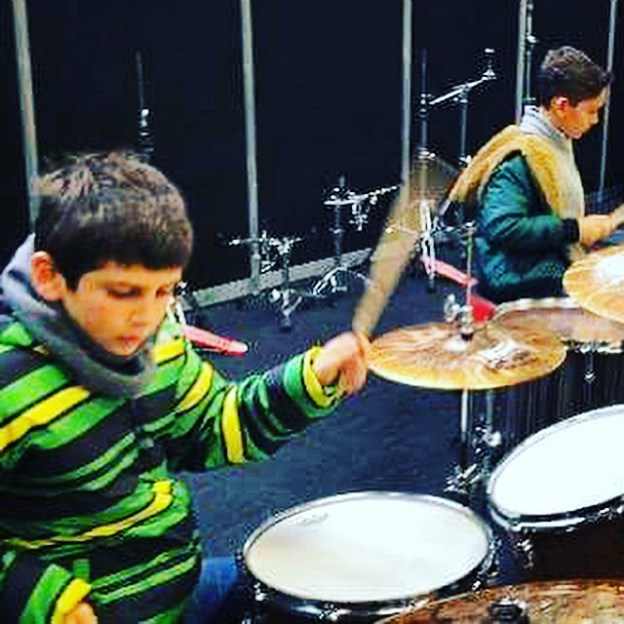
Then there are the musical instruments of course. The piano, played only with the foot constantly to the pedal, and the bass. And the drums. The drums played without the silencing pads.

And the music that stays on long after the premises have been vacated. Music is always in the background.

Boys also like to watch noisy things: a football match with all the cacophony of the stadium, action movies with long car chases and noisy exhausts, war movies. All with the volume pitched high.

And then there’s Big Boy Number One, of course. My husband loves to watch replays of football matches he’s already seen a couple of times already. If his favored team had actually won, I get treated to replays and commentary on television, tablet, phone…Location doesn’t matter either: bathroom, kitchen, bedroom, living room…it all works. This doesn’t bother me, I have to admit, except when I’m trying to read or I’m concentrating on something else, happily and quietly in my bed, in which case the commentary becomes quite a distraction.

Especially if it’s in German.

(Neither my husband nor I speak or understand German.)

And here’s an observation I made the other day. Boys don’t notice when a sound is too high, only when it’s too low. My eldest son recently joined the school choir and we were, naturally, invited to watch his first concert. It was really great to go and watch his lips move.

“How did you like it?” he asked me hopefully at the end.

“I liked it a lot though I would have liked it even more if I had heard you,” I replied, “your father was complaining that he couldn’t hear you at all! You sing louder than that when you sing alone at home,” I tried, wanting to offer one positive-sounding comment at least.

“Yes well, we were asked to keep it soft and melodious,” he explained.

“Well maybe that’s the problem,” I said. “Next time keep it loud…and try singing in German.”